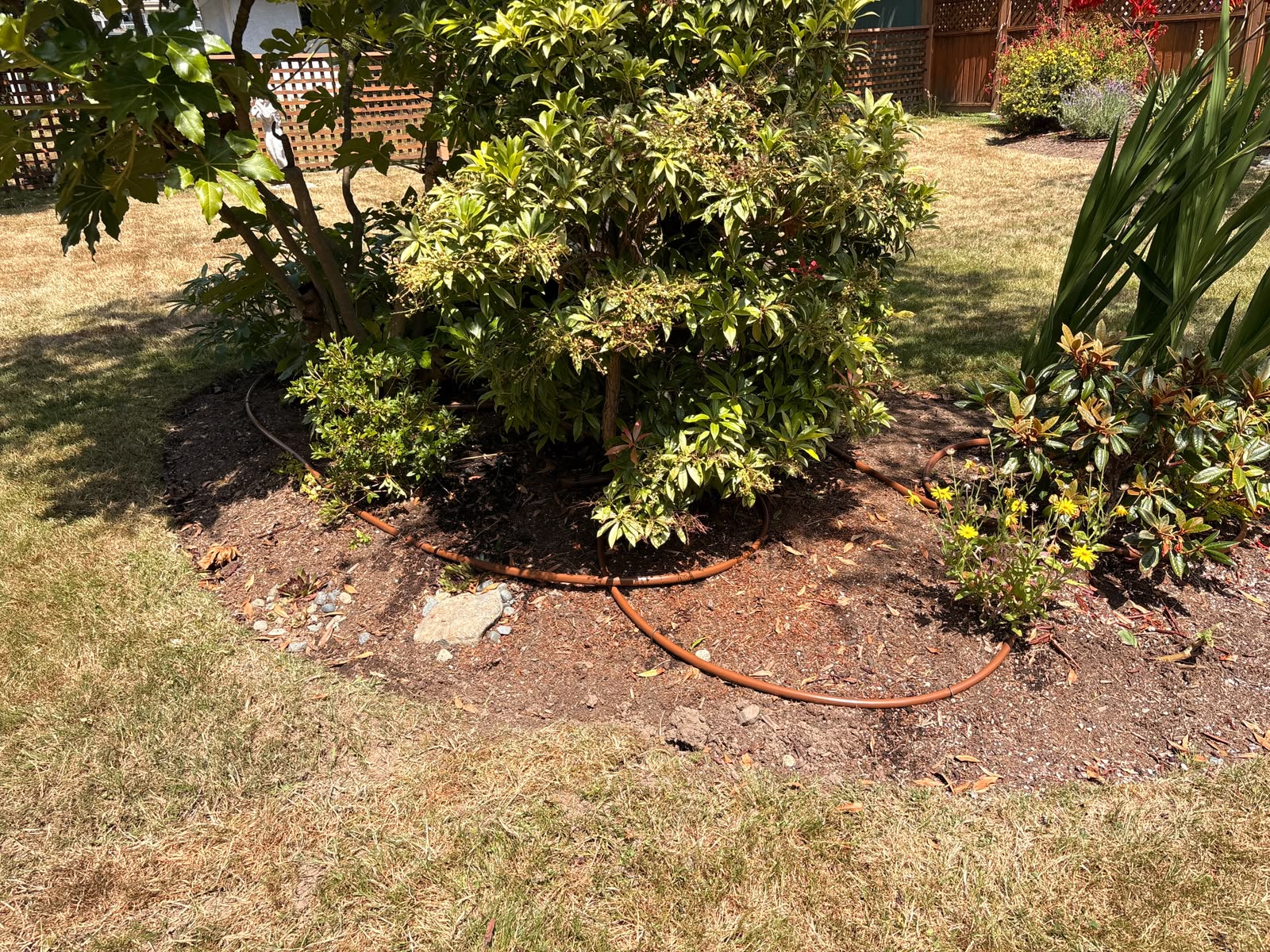
Drip Irrigation Installation in Sidney, BC: A Third Street Case Study
Project at a glance
- Location: Third Street, Sidney, BC
- Service: New drip irrigation installation
- Zones: Four
- System type: Drip
- Zone piping: 3/4 inch
- Valves: Rain Bird, with 30 PSI Rain Bird pressure regulators on each
- Manifolds: Two, built with Dura easy disassemble fittings
- Water source: Dedicated tee off the main line with its own shutoff and backflow preventer
- Winterization: Blowout fittings installed for direct compressor connection
- Landscape: Mixed shrubs and flowering plants, standard residential lot
- Main challenge: Rock hard clay soil requiring hand digging
- Completed: Summer two thousand twenty six
- Result: Hand watering eliminated, outdoor water use down roughly thirty percent
Background
For four growing seasons, this client, the homeowner of a property on Third Street in Sidney, kept a mature planting bed alive by hand watering. The property held a mixture of shrubs and flowers across a normal sized residential lot, and every dry stretch meant hauling a hose from bed to bed, watering can in hand, trying to remember which section had been done and which had not. It is a routine a lot of Sidney irrigation owners recognize. Manageable in June, exhausting by August, and never quite even no matter how disciplined you are about it.
The water bill kept climbing every summer, and the coverage was never even. Some plants got soaked while others dried out between visits, since hand watering depends entirely on memory and available time rather than a fixed schedule. Over four seasons, that inconsistency adds up. Some shrubs establish well while others stall out, and the homeowner is left wondering why one bed thrives and the next one struggles despite getting attention on the same day.
The client came to Waterworks Irrigation with two goals in mind. Stop hand watering for good, and water the property in a way that used less, not more. Saving money on the water bill mattered, but so did doing it responsibly, watering ecologically and efficiently rather than just switching to an automated sprinkler system that solved the labour problem while making the water problem worse. A properly zoned drip system was the answer to both.
–
The Unique Sidney Climate and Soil Challenge
Underneath the beds, our crew ran into rock hard clay that had to be dug by hand, with extra care around existing plantings so we did not risk root damage. This slowed the dig considerably. Clay compacts fast once it is disturbed, and it holds water very differently than the loam or sandy soil we see on many other Sidney properties, so trenching had to be precise from the first cut.
Sidney sits in the Saanich Peninsula rain shadow, which means long dry stretches from roughly June through September and very little natural relief during the months plants need water most. Combine that with dense soil and you get the worst of both conditions. Long dry periods, and ground that sheds surface water instead of absorbing it.
Every line placement and emitter location was planned around the existing shrubs and flowers rather than laid out on a generic grid. The crew worked through the difficult digging conditions methodically, section by section, rather than rushing the layout to save time.
–
Why Drip Irrigation Works for Clay Soil
Waterworks installed a four zone drip irrigation system built around the mixture of shrubs and flowers already established on the property. Splitting the property into four zones let us match run times and emitter spacing to plant type instead of using one blanket setting for everything, which is where a lot of do it yourself or one size fits all systems fall short.
Shrubs and flowers root at different depths and use water differently. Shrubs generally want deeper, less frequent watering that encourages roots to grow down into the soil, while flowering plants often prefer shorter, more frequent cycles closer to the surface. Treating both the same wastes water on the plants that need less and can leave the more demanding ones underwatered. Four separate zones meant each planting type got a schedule suited to it rather than a compromise that served none of them particularly well.
Drip was the right call here for the soil as well. Drip lines deliver water slowly and directly to the root zone, which gives dense ground the time it needs to absorb water rather than pooling on the surface and running off. That runoff problem is common when a spray or rotor system gets installed on clay, and it is one of the most frequent reasons we get called out to fix an existing system on the Peninsula.
–
How the System Was Built
The details below are what separate a system that runs cleanly for fifteen years from one that gets called in for repairs every spring. Most of it is invisible once the beds are backfilled, which is exactly why it gets skipped by installers cutting corners.
A dedicated, isolated water supply. Rather than tapping in wherever was convenient, we made a proper splice into the main water line entering the house and teed off it, then gave the irrigation system its own shutoff valve and its own backflow preventer. That means the entire system can be shut down independently, in winter or for any repair, without touching the water supply to the house. The dedicated backflow preventer also protects the potable supply from any cross contamination out of the irrigation lines, which is a code requirement and not a place to improvise.
3/4 inch piping to each zone. Every zone runs on 3/4 inch pipe. On a four zone residential system this is the size that maintains adequate flow and pressure to the furthest emitters. Undersize the pipe and the last plants on the run get starved while the first ones on the line get everything.
30 PSI Rain Bird pressure regulators after every valve. This is a standard on every drip install we do, without exception. Drip irrigation is specifically rated to operate at 30 PSI. Residential water supply typically arrives at considerably higher pressure than that, and drip components are not built for it. Run drip at full house pressure and two things happen. The emitters do not distribute water at their rated rate, so the system does not water evenly or predictably, and the fittings themselves start blowing off the lines. We see this constantly on systems installed without regulators. The homeowner assumes drip irrigation is unreliable, when the actual problem is that the system was never pressure regulated to the specification the components require. Installing a regulator after each Rain Bird valve costs very little at install and eliminates an entire category of failure.
Two manifolds built with Dura easy disassemble fittings. The valves are grouped into two manifolds, assembled using Dura fittings that come apart without cutting. When a valve eventually needs replacing, and after enough seasons one always does, the repair is a disassembly and a swap rather than cutting into glued PVC and rebuilding a section. That is a meaningful difference in labour hours, which means a meaningfully smaller invoice for the homeowner years down the line.
Male PVC to poly adapters at the transition. The rigid PVC mainline transitions to the flexible poly drip tubing through proper male PVC to poly adapters. This is a common failure point on rushed installs, where an improvised transition works for a season and then separates under pressure or ground movement.
Winterization fittings for compressor blowout. Sidney gets hard enough freezes that water left sitting in irrigation lines over winter can split pipe and destroy fittings. We installed dedicated winterization fittings that connect directly to a compressor, so blowing the system out each fall is fast and straightforward rather than an awkward improvisation with adapters. Faster winterization means a lower annual service cost, and a system that gets properly cleared every year lasts substantially longer.


The Resulting Sidney Irrigation System
Since installation, our client has not hand watered the property once. Early estimates put outdoor water use down by roughly thirty percent compared to the previous routine, since drip delivers water directly to the root zone instead of losing a portion to evaporation and overspray the way a hose or sprinkler does.
Plant health has also improved. Shrubs and flowers across all four zones now show steadier, more even growth, because every section runs on a consistent schedule matched to what it actually needs instead of whatever the homeowner had time for on a given evening. With regulated pressure at every zone, the emitters deliver at their rated output, so coverage is genuinely uniform rather than approximately so.
Beyond the savings and the healthier beds, she has gotten back the time that used to go into watering every few days through the growing season. That time and mental load, remembering the schedule, dragging the hose out, checking which beds were missed, is now handled automatically.
–
What the Client Said
The client left a five star review of the project, calling the pricing reasonable and noting that the crew worked hard through difficult digging conditions, including the clay that had to be dug out by hand. She described the small army of workers turning up as arranged and working hard throughout.
She specifically credited Dmitri for supervising the job and explaining and consulting with her very patiently and thoroughly along the way, and Ryan for keeping her informed of progress from start to finish. She said everything was done well, and added that she feels confident Waterworks will continue to help her with the maintenance and operation of her new system going forward. That last point matters. A five star install is one thing, but ongoing trust in the company for maintenance and support is what keeps a system running well for years, not just the first season.


Common Questions About Drip Irrigation in Sidney
–
Why does drip irrigation need a pressure regulator?
Because drip components are rated for 30 PSI and household water pressure is usually well above that. At higher pressure, emitters do not deliver at their rated output, so coverage becomes uneven and unpredictable, and fittings pop off the lines. A 30 PSI regulator installed after each valve brings the system to the pressure the components were designed for. We install them on every drip system we build, and most of the failing drip systems we get called out to repair are missing them.
–
How does drip irrigation perform in clay soil?
Better than spray or rotor systems, because it applies water slowly enough for dense ground to absorb it. Clay has a low infiltration rate, meaning it accepts water gradually. A sprinkler puts down more water per minute than clay can take in, so the excess runs off or pools. Drip emitters release water at a rate the soil can keep up with, which puts more of it into the root zone and less of it on the surface.
–
How many zones does a typical Sidney property need?
It depends on plant types and water pressure more than square footage. A standard residential lot with mixed plantings, like the Third Street project, commonly lands between three and six zones. The number is driven by how many different watering schedules the landscape actually requires, plus how much flow is available from the water source.
–
Does an irrigation system need its own shutoff and backflow preventer?
Yes on both counts. A dedicated shutoff lets you isolate the irrigation system for winter or for repairs without cutting water to the house. A backflow preventer stops irrigation water from being drawn back into the potable supply, which is a code requirement, not an upgrade. We tee off the main line and install both as part of every system we build.
–
How is an irrigation system winterized in Sidney?
Water is cleared from the lines with compressed air before the first hard freeze. Systems installed with dedicated winterization fittings can be connected directly to a compressor, which makes the annual blowout quick and inexpensive. Systems without them take longer to service, and any water left sitting in the lines over winter can split pipe and destroy fittings.
–
Can drip irrigation be installed around established plants?
Yes. It is one of the main advantages of drip over other systems. Lines can be routed around existing shrubs and beds with minimal disturbance, and emitters are placed at individual plants rather than requiring a uniform grid layout across the yard.
–
How long does an irrigation installation take?
A typical residential system goes in within a few days. Difficult soil conditions, like the hard clay on this Third Street project, can extend that timeline since sections have to be dug by hand rather than with machinery.
–
Still Hand Watering in Sidney?
Every season spent hand watering is a season of higher water bills, uneven coverage, and plants under more stress than they need to be, especially with the clay soil common across parts of Sidney. A properly zoned drip system fixes all three at once, and it does it while using less water rather than more.
If your Sidney property is due for an upgrade, whether you are dealing with the same hard clay, a mixture of plants that need different watering schedules, or you are just tired of hauling a hose around the yard every few days, get in touch with Waterworks Irrigation to talk through what a system built for your specific beds would look like.
GET A FREE QUOTE